Practical tips on JR PASS

© Henry Perks, Unsplash
The best mode of transportation in Japan is the train. It is fast and efficient and very easy to use.
Japan is the country of trains, with probably the densest network in the world, the highest traffic... It has therefore developed a culture of train travel unique in the world. To make the most of this experience, discover all our practical advices gathered by our team!
All the information you need
-
Jorudan
We recommend Jorudan. Since April 2022, the popular Hyperdia application is no longer updating train schedules and Jorudan is the best alternative navigating application in Japan.
-
The JR Pass information site
The official Japan Railways information site translated into English. It is especially useful to find out where the JR Pass exchange office is located in stations in Japan. Go to the site: Japan Rail Pass Exchange Offices
-
Google Transit in Japanese
This site is very effective although it is in Japanese. Calculate your journey time and train connections. Go to the site: Google Transit
-
Downloadable maps and plans
Several maps are available on the internet for you to download. Here is a useful selection.
At the stations
-
Exchange your voucher for a JRP
To use the trains on the Japan Railways (JR) network, the voucher given to you at the time of purchase must be exchanged at a JR ticket office. The list of stations where you can exchange it is shown on your voucher. All the major stations in Japan and Tokyo in particular have a dedicated ticket office.
-
Using your Japan Rail Pass
The Japan Rail Pass means you don't need to buy tickets for every journey (except if you want to book a seat on a Shinkansen).
You therefore need to go through the free passage area staffed by the ticket inspector (and not through the gates). It is a good idea to have your passport with you as the ticket inspector may want to check that you are the Rail Pass holder.
-
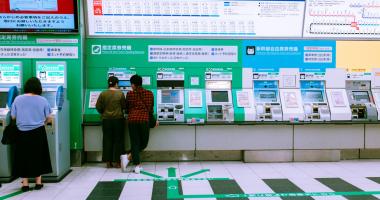
Use the automatic ticket machines
For the metro (in Tokyo in particular) or on certain private train lines, you must buy your ticket from the automatic machines.
The idea is to locate the amount necessary to go to the station that you are interested in, by looking at the large panels generally located to the top of the ticket machines. Then insert this amount in the ticket machine which will print your ticket. Each of these distributors is available in English.
-
Book your Shinkansen seat at a ticket counter
To book a seat on board a mainline train (Shinkansen), you need to ask for your ticket numbered in a "JR Ticket Office" identifiable by the green signs. This booked seat is called "Shiteiseki".
Of course, you can also take sit where you want: this is the "jiyuseki" system. Finally, since 2007 Japanese trains are all non-smoking, with the exception of some of the mainline trains which are equipped with smoking cars. The same rule applies in the station platforms.
-
The station as a shopping centre
Historically the train companies were big trading companies that built very large shopping centres at the same time as the train lines. Therefore the stations are often in large shopping centres.
-
Places to eat at the station
The stations contain specialist stalls selling Ekiben or station bentos, the contents of which are often influenced by the local specialities. There are also many restaurants which are open non-stop and serve many types of food, with something to suit all tastes.
-
Leaving the station
Stations often have several exits and are often very large. Don't hesitate to ask a ticket inspector what exit to take for the place you want to go to.
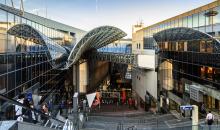
In Kyoto, the central station is a complex with a very large luxury hotel (Granvia), a big store (Isetan) and a very big audiovisual product shop (BicCamera), an underground shopping centre, a very large Tourist Office, etc…
-
Finding your train
The train number and destination are always shown in Japanese and Latin characters. On many platforms, floor markings show where the train doors are located. The trains stop exactly at the door marking location.
It is a good idea to queue to access the door as the trains do not stop for long. Additionally, seats are not booked in advance on local trains and the sooner you board, the better your chances of securing a seat.
Don't hesitate to ask a traveller on the platform if the train you are waiting for is going to your destination.
Finally, be careful not to take a "Nozomi" train on the Tokyo-Nagoya-Kyoto-Hiroshima line. You must board the "Hikari" or "Kodama" which make a few extra stops.
-
Waiting for your train
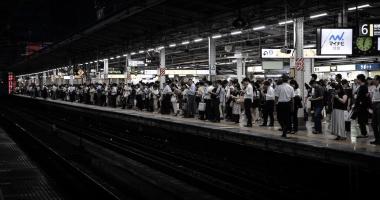
There is a certain discipline involved in waiting for your train on a station platform in Japan: choose a queue (generally indicated by floor markings), and patiently wait behind the other passengers until you can board the car, quietly of course (we are in Japan after all).
-
Carrying your luggage
There is no porter service at Japanese stations. The major stations have escalators and lifts but the small stations only have steps. If you are going on a trip lasting one or two days, you can use the Takkyu-bin luggage-sending service for a modest fee to have your luggage delivered to your destination.
Example: You are departing from Kyoto for Tokyo and want to spend 2 nights in Takayama and Kanazawa. For these 2 nights you can keep a minimum amount in a bag and have your suitcase delivered to your hotel in Tokyo.
-
Using the automatic luggage locker
With the lockers you can stop for 2 or 3 hours in a town, take a tour and then continue your journey on the next train. For example, departing from Kyoto on the Okayama route: you can only visit Himeji (2 ½ to 4 h) if you leave your luggage behind.
Most of the major stations have quite large lockers (sometimes in limited numbers however). It is easier to fit in 2 medium-sized bags than a large suitcase. Small stations sometimes do not have lockers for large suitcases: it is better to have soft bags that be easily squashed down than rigid suitcases.
There are also traditional lockers with a service ending quite early in the evening.
-
The station as an information centre
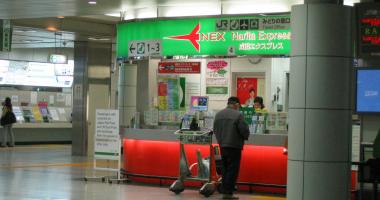
Nearly all stations have a tourist office. There is plenty of literature (unfortunately this is often only available in Japanese) to help you discover places of interest in the town or the region. Employees often speak English and can help you make hotel bookings.

La gare d'Osaka
© Andrew Leu, Unsplash
On the trains
-
Storing your luggage on the train
Unlike European trains, Japanese trains do not provide much space for large suitcases. Large cases can generally be stored behind the last seats at the start or end of the car. And your smaller items of luggage can of course be stored above your seat.
-
Finding the right spot on the train
When you are travelling in the daytime, consider using the train to take a tour.
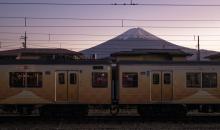
This will give you untrammelled views of Mount Fuji when travelling to Tokyo from Kyoto, in particular if you are sitting on the left (which corresponds to seats in row E).
The same applies when travelling to Kanazawa from Kyoto to see Lake Biwa (sitting on the left).
On local trains and on certain Limited Express trains, the train driver's cabin is see-through and provides panoramic views of the landscape. This is the place to be. For example, when crossing the inland sea from Honshu to Shikoku, the first 2 seats on the right behind the driver provide an impressive view of the inland sea.
-
Enjoying all the comforts of Japanese trains
All long-distance trains have comfortable reclining seats.
The seats can be turned round by 180°C; as well as enabling you to always be facing forwards, these seats will enable you to travel in a group easily by forming "squares".
The trains all have Western-style toilets and you can make telephone calls on most trains. A smoking area is often available between the cars.
-
Avoiding peak times
Peak times in Japan are between 7 am and 9 am and 5 pm and 7 pm. Most trains are generally overcrowded at those times and make it very difficult to move around with large items of luggage.
-
Eating on board
You will never go hungry on a Japanese train. Major stations offer a wide range of bentos which often contain a local speciality.
Additionally, if you haven't had time to buy a bento, there is a regular trolley service in the cars (except for local trains). Enjoying a delicious ekiben while you watch the scenery go by is one of the highlights of the trip.